

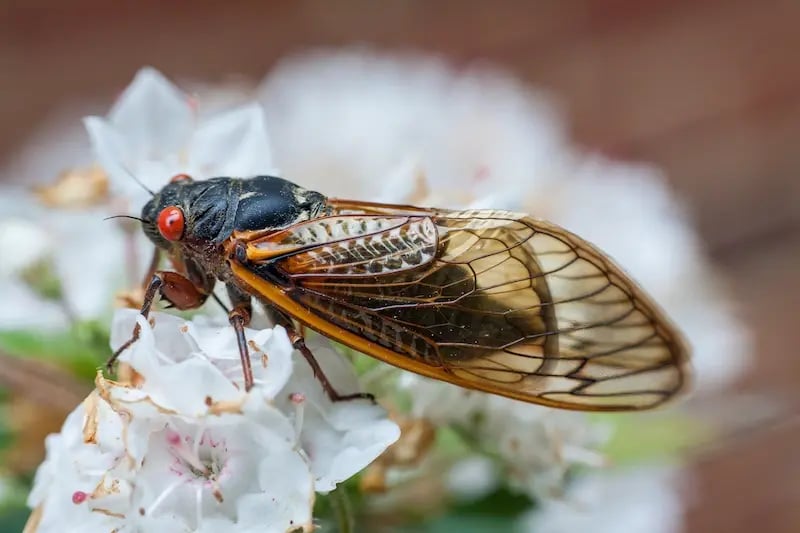
In Spring and Summer 2025, cicadas will be out and about in huge numbers in New Jersey and Pennsylvania. We deal with cicadas every year in our region, but this year’s emergence will bring elevated levels of cicada activity. This is because we’ll be welcoming periodical cicadas, in addition to the usual annual cicadas that emerge every year.
When Do Cicadas Emerge in New Jersey and Pennsylvania?
Annual cicadas emerge in the spring or early summer every year. Temperature is the biggest factor on when exactly they will show up in a given year. Cicadas enjoy warm weather, so if seasonal temperatures are unusually warm, they may come out early. Whereas if it’s a cooler than average year, they may not show up until later.
After spending 13 or 17 years developing underground, periodical cicadas emerge in mid to late summer. It’s hard to miss the arrival of periodical cicadas because they’re extremely noisy, and there are literally tons of them.
Periodical cicadas are identified as belonging to certain “broods” that show up in 13 or 17-year cycles. Different broods have multiple cicada species. 2025’s brood is known as “Brood XIV”; it primarily consists of three cicada species:
- Cassini Periodical Cicada (Magicicada cassinii)
- Decim Periodical Cicada (Magicicada septendecim)
- Decula Periodical Cicdada (Magicicada septendecula)
Upcoming Cicada Broods in New Jersey and Pennsylvania
Cicadas are expected to be busy in New Jersey and Pennsylvania in 2025. If you’re not a fan of cicadas, fortunately for you, 2026 is expected to bring fewer. However, additional large cicada broods are on the way, and here’s when you can expect them:
- 2030 (Brood II)
- 2033 (Brood V)
- 2036 (Brood XIII)
What’s the Difference Between Annual and Periodical Cicadas?
The difference is how often you see them. Annual cicadas, as the name suggests, appear every year. Periodical cicadas emerge after 13 or 17 years underground. There are numerous theories for why periodical cicadas do this, including predator avoidance and evolutionary adaptations harkening back to the Ice Age, but there is no scientific consensus.
Many people misunderstand how periodical cicadas work, that you only see periodical cicadas every 13 and 17 years. Actually, we see periodical cicadas every year – each year has its brood of periodical cicadas that have been underground for 13 or 17 years and are now ready to emerge. Some of those broods are larger than others. Brood XIV, which will emerge this summer, is forecasted to be a large brood.
There are about 3,000 cicada species worldwide. Aside from slight behavioral and differences in appearance, they are more similar than not. Here are some common traits to cicadas:
- Cicadas are large insects known for their loud buzzing song and unique life cycle.
- They spend most of their lives underground as nymphs, feeding on tree sap.
- Adult cicadas can fly.
- Cicadas have large eyes, clear wings, and can be up to 2 inches long.
- Can be attracted to the sound of power tools and lawnmowers.
Are Cicadas Dangerous?
Cicadas, though numerous and noisy during mating season, are essentially harmless. They neither bite nor sting, and are not typically viewed as pests in the traditional sense.
While they pose no real danger, cicadas can be irritating. Egg-laying in tree branches can lead to broken or damaged limbs, especially in young trees and shrubs.
Can You Get Rid of Cicadas?
While it’s impossible to completely get rid of cicadas because there are just too many of them, these measures can help limit their impact on your property.
- With young trees and shrubs, cover with netting to stop cicadas from laying eggs.
- Refrain from planting new fruit trees or bushes during cicada emergence.
- Minimize noise from lawn equipment during the day to reduce cicada activity.
- Gently remove cicadas from plants and surfaces using a garden hose.
Cooper Pest Solutions: Your Local Cicada Experts
Cicadas are a highly unique insect. They emerge quickly, make a lot of noise, and disappear just as quickly. While they can be highly irritating, it's important to understand that standard pest control methods are largely ineffective against them. Their sheer numbers make eradication impractical; even if every cicada on a property were eliminated, countless others would soon arrive.
The good news is that intervention is you don’t have to do anything. Cicadas will naturally disappear within a few weeks. Therefore, we recommend not be overly concerned about the cicada season, despite any temporary annoyance they may cause.
If you do need assistance with other pest issues, don’t hesitate to contact the professionals at Cooper Pest Solutions. Our team has the knowledge and experience to handle other pest problems, no matter how big or small. We’ll work with you to develop a customized treatment plan that fits your needs and budget.
Learn more about our pest control services or reach out to us today to get started with a free service quote!